advanced40+ hours54 sectionsUpdated Jun 15, 2026
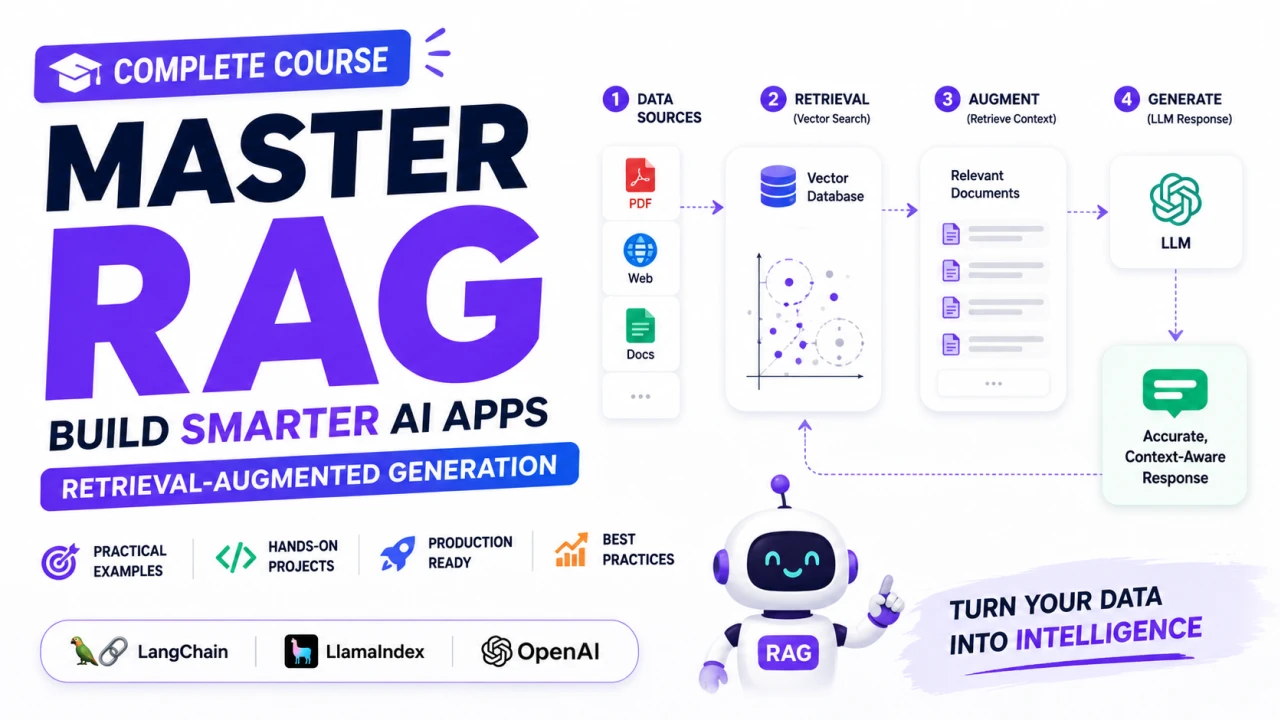
A comprehensive, end-to-end course through Retrieval-Augmented Generation — beginning with core concepts and document processing, advancing through embeddings, vector stores, and retrieval techniques, and culminating in agentic RAG systems built with LangGraph and a deployable capstone project.
What you'll learn
- Understand the RAG architecture and when to use it vs fine-tuning vs prompt engineering
- Master document processing, chunking strategies, and metadata management
- Select and implement appropriate embedding models for different use cases
- Deploy and operate vector stores including Chroma, FAISS, Qdrant, and Pinecone
- Implement basic and advanced retrieval techniques including hybrid search, MMR, and re-ranking
- Build advanced RAG patterns: RAG Fusion, HyDE, Corrective RAG, Self-RAG, and Graph RAG
- Design and implement agentic RAG systems using LangGraph with multi-step reasoning
- Evaluate RAG pipelines using RAGAS with comprehensive metrics
- Deploy a production-ready RAG system with monitoring, caching, and optimization
Prerequisites
- Python fundamentals (functions, classes, async/await)
- GenAI fundamentals (LLM basics, tokens, prompting)
- LangChain basics (Chains, LCEL, tool usage)
- LangGraph basics (StateGraph, nodes, edges, conditional routing)